Monday, 4 July 2011

Water Pump Won't Pump Water!

The last episode of the Worthington-Simpson Boiler feed pump destined for the cab left a cliff-hanger: it was merrily allowing air to be blown through the pump section forwards or backwards.  As such, the chances of it actually being much better when faced with pumping water were not good. And guess what?  I was dead right; not a sausage of a spurt!

Up to this point, I'd looked fairly carefully at the steam end but ignored the water end of the pump assuming it would 'just work'. I should have known better; it's always the assumed bits (that make an 'ass' out of 'u' and 'me') that don't work.

I began with the section drawing.

WS BFP Pump Section
The inlet is the lower and the outlet the upper of the orifices on the right hand side. The inlet feeds up through the middle of the two cylinders to the lower of the two banks of four valves. As the pistons move back and forth, they suck water in through the lower set of valves and then blow out through the upper set; the valves enable water to pass one way against a spring pressure but lock themselves closed for the other way. Hence they are non-return valves (a bit like diodes if you are that way inclined).

Even though I'd previously suspected the piston rings, the fact that I could easily blow through would not be affected by the piston rings. Therefore it had to be the valves so I took them apart one by one.  Fortunately, a large hex key worked well to undo them all.

Hex key removing the valves
(with a little help from me when needed but it sat there just nicely for the photo!)
Being a water pump, all fittings are brass and not corroded despite being 60 years old.
Top view (water is pumped up from below the valves)
All of the upper set of four outlet valves are clear and in good condition.
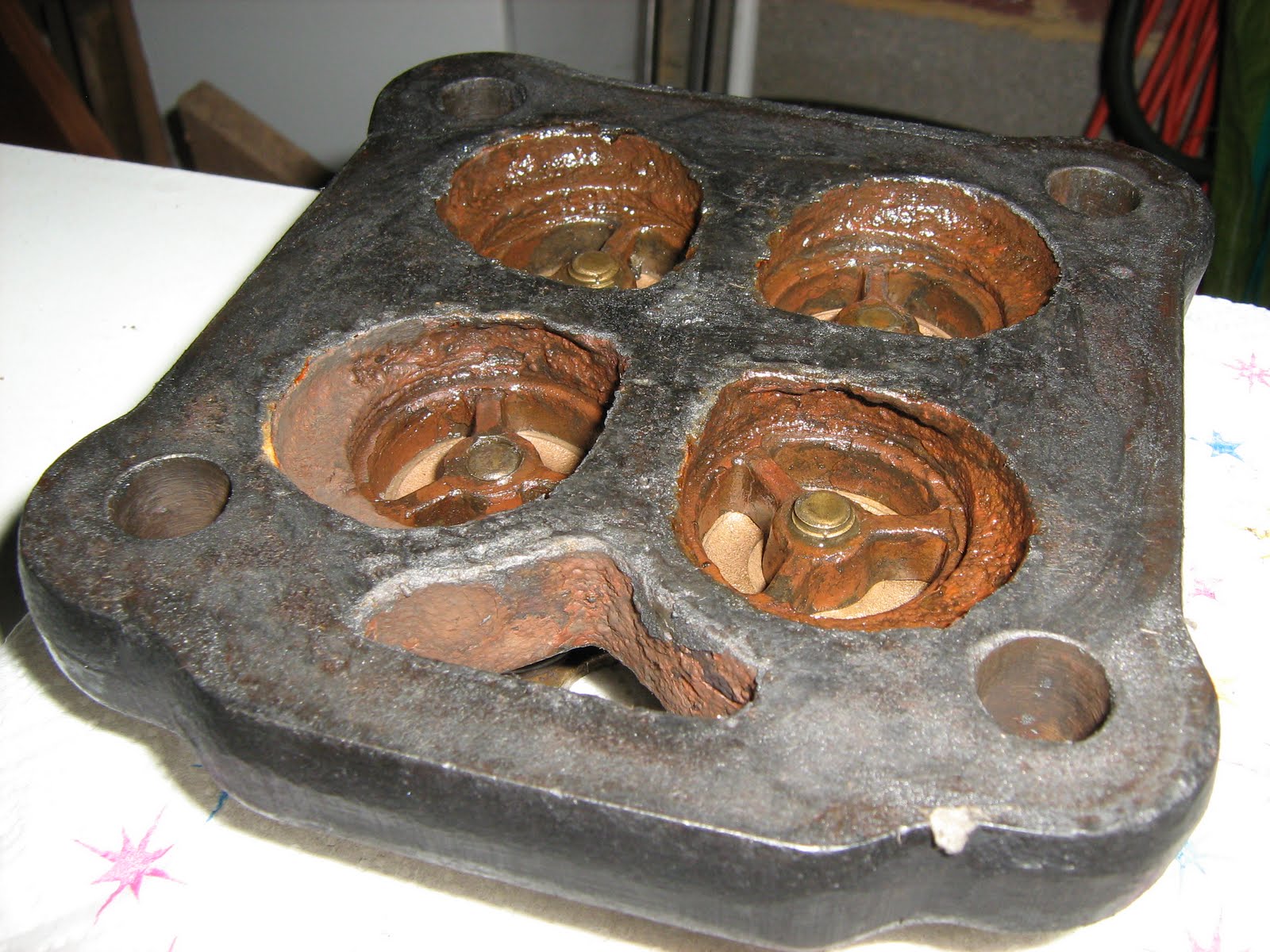
View of valve seats from underneath
The lower set which receives the incoming water was rather more interesting. Clearly a filter had not been used to sift out rubbish and something akin to pieces of a matchstick and other 'detritus' had got into the seats of three of the valves.
One of the offending pieces of matchstick...
... and where it was not very usefully lodged!
Detritus (bits of old sock to you and me) also in the works.
No socks-appeal here!
Having cleared all the bits and pieces and reassembled the valves and the pump section, it was clearly harder to blow any air through albeit that there was not a complete seal so perhaps the valve faces will need regrinding. So, the bit you've been waiting for, here's a little more video with the valves seated. (Also on YouTube).
As well as the view from the water end, there is also a very subtle acoustic difference to before in that there is a feint 'raspberry' in time with the pump strokes. But as with deep-seated raspberries, you'll probably need a good subwoofer with your speakers to hear it!

Just to complete the picture, some photos follow of other WS bits and pieces.

Valve components
Broken spring, later suitably 'bent' into shape and stretched to fit.
Now, how to ensure that it will pump into 275psi boiler pressure! Continued here.

Wednesday, 29 June 2011

Sentinel 8805

In February 2011, I attended the Sentinel Drivers' Club AGM in Basingstoke. In conversation after the formalities, I met Norman Smedley who proclaimed that, in the boot of his car, he had a 7.25 inch gauge model of the unique LMS Sentinel-Doble shunter numbered 7192.

Not the normal car boot contents I thought (with raised eyebrows) and, at Norman's invitation, went to have a look.

Although 7109 is a 12 inch to the foot scale, I've long admired the amazing amount of time and effort that goes into model locos. This was another moment of admiration.

Car boot contents (1)
Car boot contents (2)
Amazing detail (and not just the boot catch!)
Right hand side
Norman sent me this photo recently of the model nearing completion and what a fantastic model it is! I'm very much looking forward to seeing it in action.
Nearing completion (June 2011)
The 'prototype' for Norman's model was the only true Doble loco built by Sentinel, works number 8805, and delivered to the LMS in 1933. It was driven by two 150 HP Doble engines, one for each axle, and had an oil-fired 1500psi boiler and condenser! Whilst it performed well, it was too complex to maintain and was withdrawn in 1943. (Norman's model will be battery powered!).
Sentinel 8805 (Photo Tony Thomas)
And again (Photo Tony Thomas)
As 7192 numerically follows Radstock's 7190 and 7191, this is the reason why 7109 will not carry the number 47192. See also 7109 Restoration.

Monday, 27 June 2011

Sentinel 7109's Superheater passes 550psi Hydraulic test

After repairs, a boiler has to pass an initial hydraulic test (water) at 1.5 times working pressure to ensure that it is physically sound. The superheater, because it works at a higher temperature to produce dry steam, has to pass its initial hydraulic test at 2 times working pressure. For a Sentinel, this means 550 psi (~38 bar).

I'd thought that the hydraulic test would require some pretty sophisticated equipment; however, this is not the case.

First the far end of the tubes need to be blocked. The sealed ends can be slackened to let air out so that there is only incompressible water contained.

Blocked superheater tube-ends
Then an artistic arrangement of pipework is attached at the near end (the bicycle wheel is not essential).
Artistic pipework
The hydraulic pump is then connected to the artistic pipework and pressure applied.
Check the gauge reading...
...this one's easier to read.
About 565 psi (39 bar)
So how is the pressure applied, I hear you ask? (Note the video was shot by the owner). Starring Justin & Pete.


(Any suggestions for the owner to do the hard work are met fiercely by the camera lens!). Clearer video on YouTube.

The pressure has to be held for at least 30 minutes. If satisfactory, then the test is deemed passed and a certificate written on the spot and issued.
Al fresco computing
Many thanks to Justin Goold of J R Goold Vintage Steam Restorations Ltd and Peter Hawkins of Hawkins Inspection Services Ltd for their services.

Sunday, 26 June 2011

Sentinel 7232 Ann

As background to the restoration of Sentinel 7109, I've visited some other Sentinel locos and, in some cases, done a pretty thorough photo-reconnaissance  of internal bits and pieces.  My visit to the picturesque Embsay and Bolton Abbey Railway near Skipton, West Yorkshire, in June 2011 was not one of the thorough photo sessions but interesting all the same. Ian Douglas kindly showed me around.
Sentinel 7232 Ann (1)
Sentinel 7232 Ann (2)
Built in 1927, Ann is a single-engined balanced Sentinel steamer rated at 80hp. It spent its working life at British Tar Products Ltd, Irlam, Manchester UK. Now at Embsay, it has not run since 2007 due to safety valve problems and the boiler being out of ticket.  Its operating future is uncertain (June 2011).

More details are available from the Embsay and Bolton Abbey Railway website.

Saturday, 25 June 2011

Sentinel 7109's Blowdown Valve

The blowdown valve is used for clearing out (blowing down) accumulated scale, rust and assorted particles from the bottom of the boiler. 7109 was missing this item on arrival and it has taken a long time to find one capable of handling the high 275psi boiler pressure. John Goold has obtained a new old-stock type as in the picture with 4.25 inch diameter undrilled flanges.
New Old-stock Blowdown Valve
It has to be fitted on to a flanged "drain-pipe" at the bottom of the boiler (it has been cleaned up and the snow has melted since this December 2010 picture was taken).
Blowdown valve "drain-pipe" flange
And then there is the spanner needed to operate the valve from a suitable distance. And the angle of attack to avoid the spanner operator from being steam-cleaned!
Related Posts Plugin for WordPress, Blogger...