Tuesday, 13 December 2011

Season's Greetings...

...and thank you for being interested in the restoration of Sentinel 7109 "Joyce". I'll do my best to keep up the 'blog's standard in 2012!
At 83, young Joyce playing in the snow on Boxing Day 2010
(I must make some Xmas cards with this photo for next year)
When I began the 'blog in May this year, I wasn't sure how it would develop and how it might affect progress with the restoration activities. In actual fact, the restoration has fed the 'blog and the 'blog has fed the restoration giving each activity a feeling that it is complete when lodged in the blogosphere.

I've also found that visitors to Midsomer Norton Station are starting to ask me more informed and searching questions lately (who's leaking the information, I wonder?). I even get a few 'blog comments, some sensible, some humorous. I'll leave you to figure out which fall into which category!

There is probably not much more to blog in 2011 but you never know. The weather has decided to cool it emphatically and contact with cold metal drains body heat in no time through gloves, footwear and clothing; not a pleasant experience.

The arrival of the DMU at Midsomer Norton has left Joyce isolated in the platform opposite the maintenance facilities of the goods' shed. Much anticipated activity has had to take a back seat and, after three weeks, I'm still waiting to turn the engines on compressed air to splash the gloppy crankcase oil about in the lower gear cases. Hopefully, when Santa has been and gone, normality will return and more progress can be made.

2012 should see Sentinel 7109 in steam again for the first time since the 1960s. There's still a long way to go but most of the major subsystems' restoration has been sorted and, when circumstances allow, it will be more a matter of bolting all the bits together and lighting the fire than the endless grinding away at rust and debris ("How naive", did I hear someone say!).

Have a good break and hope to see some of you as visitors to Midsomer Norton Station in the new year.

PS If you find yourself bored over the break whilst waiting for the next posting, why not have a look at Douglas Self's 'Unusual Locomotives' web page. It's rather short on UK Sentinels at the moment, however, hopefully that won't always be the case!

Friday, 2 December 2011

Diesel Dunking for the Chains

Here's Sentinel 7109's offering for submerging a celebrity in slime!
Is it a snake?
Eel maybe?
In actual fact, this is the recommended method for reconditioning rusty chains. As of 27th November 2011, two of the huge chains described in an earlier posting are now lying in a nice moisturising bath of diesel and thin oil.

After much searching for a suitable container large enough and strong enough to take a pair of chains, a S&DRHT volunteer, Dave Read, came up with the ideal thing, an agricultural style tank which may have done service in a dairy originally! It's always a good idea to explore other technologies for solutions to your own!

The chains will remain submerged for a couple of months before further examination.

One method of cleaning the chains I was recommended was to set fire to them to dry off the diesel. How ever good an idea it may be, the H&S police would probably have a heart attack at the thought!

Tuesday, 29 November 2011

Between the Lines

Welcome to all who've found my Sentinel 7109 'blog from the link address on the back of the superb new S&DRHT newsletter 'Between the Lines'.

Well done, in particular as there is an extraneous '1' before the 7109 where it shouldn't be in the 'blog address! Oops Mr Proof-Reader!

Inter-Telegraphy: Lines, wires, poles (even Road possibly!)
I've accumulated quite a lot of information since May 2011 with the aim of recording the restoration work partly for my own reference and partly for anyone else interested in Sentinels or for anyone who's interested. I'm an engineer so no apologies for the postings being about Sentinel loco engineering and construction. No apologies also for drifting off-subject from time to time!

To find your way around, click on 'A Warm Welcome' to get started. Any text in blue is a link to either 'blog content or something else. Who knows what you might find?

Thursday, 24 November 2011

Brazed Nuts and Gear Cases

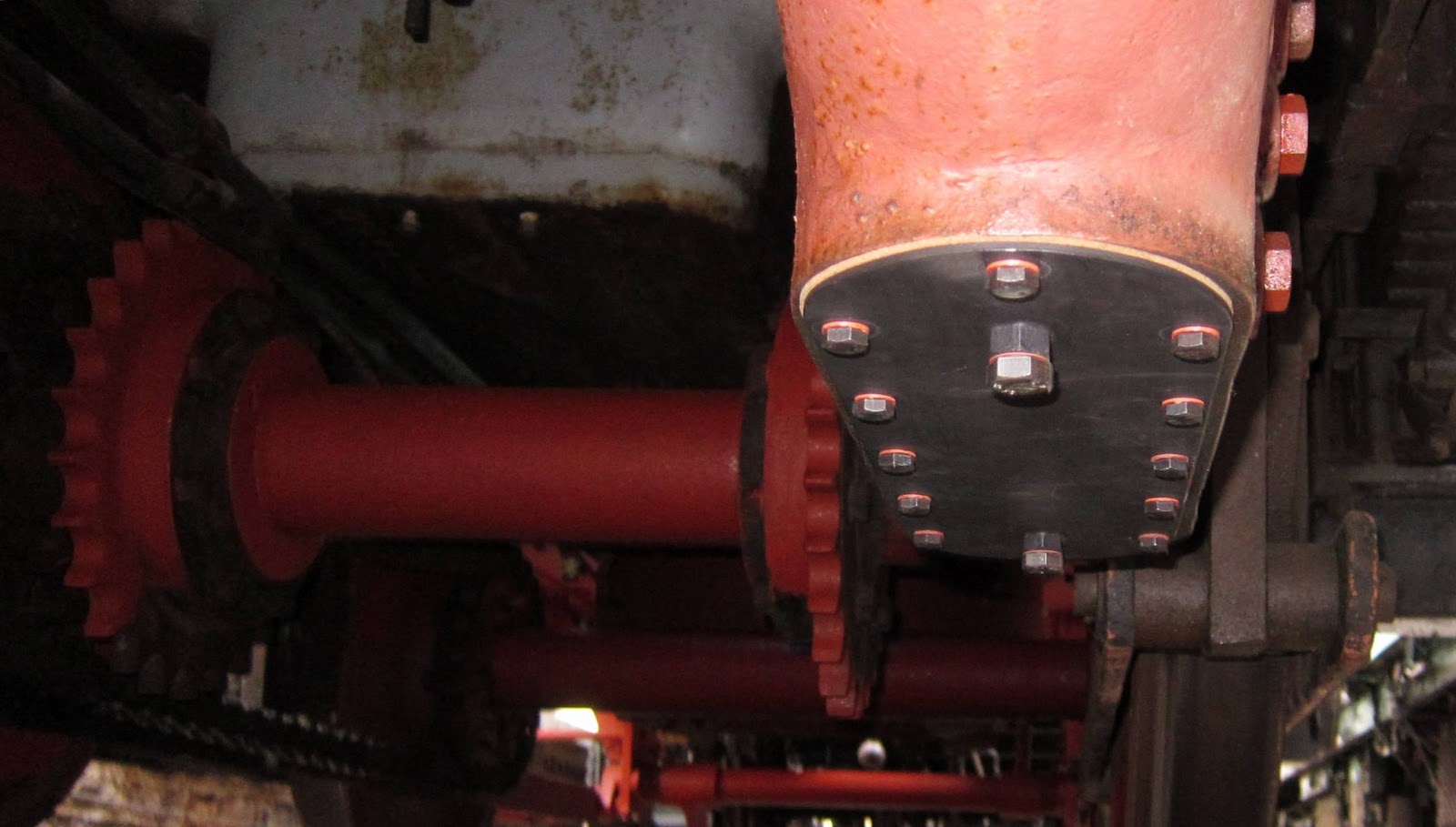
After many years of staring wonderously up into the portals under Sentinel 7109's lower gear cases, 23rd November 2011 finally saw them closed up and an oil bath created inside.
Under-frame view showing the nice pair of closed-up lower gear case portals
There are a number of requirements to be satisfied with these cover plates: they must not leak around the gasket; they must not leak around the screw threads (the holes are open inside to the oil bath); they must allow condensate to be drained off from below the oil (all of it if possible).

The gaskets are hand made from a rubberised cork material about 1/8th inch thick (3mm) using the two plates themselves as the respective templates.

Plate and cork gasket (two of each)
Preventing leakage down the screw thread is not so easy. At first, studs were tried but they were loose in the thread. These could have been secured with Loctite of an appropriate grade; however, I was concerned that the seal might not be maintained for the many years it will be required. Also, if either plate needed to be removed, undoing the nuts on the studs could loosen a stud and require it to be refitted and resealed. So I chose to use 5/16" BSW hex headed bolts with fibre washers.

[Note to me: 6 of the 24 bolts have been cut to 1/2" length for the holes which have been closed off with weld where presumably there was a problem with the gear case casting. The rest of the bolts are 1" but could be cut to 1/2" in future if wanted - unnecessary extra work!].

I'd also been recommended to use 'Dowty' washers instead of fibre; however, I had to dismiss this idea as some of the holes in the plates were not round and would allow leakage at the long end of the holes! (Offers for 25 M8 Dowty washers anyone?).

I devised a cheap method for draining the condensate using M12 nuts brazed to the underside of the plates and drilled and tapped so that a bolt could protrude right through. I milled a slot along the length of the bolts so that they could seal when tightened up but let fluid pass when loosened.

Slotted bolt and brazed nut
The key point here is that fluid needs to drain down to the surface of the plate and not allow a pool of condensate to remain that cannot be drained. One suggestion had been to use a drain cock; however, it would still need a brazed nut or threaded boss to mount it and £15 or so each is a lot more than the cost of stainless steel M12 bolts!

Use Crankcase Oil
Sentinel require Crankcase oil to be used to lubricate the gears as there can be seepage of crankcase oil through the crankshaft end bearings from the crankcase to the gear case. After some careful investigation, I selected Hallett Oils' SCC680 Crankcase oil which is designed specifically for Sentinel steam engines. It is a viscous, gloppy (onomatopoeic word) fluid that encourages any condensate to separate out and sink to the bottom (water being heavier than oil). It's this property that enables the condensate to be drained.

The gear cases needed to be filled to the second check level to suit the diameter of the gear wheel inside.

The one in the middle
At this point I realised that the gear cases were somewhat larger than I'd anticipated as they swallowed at least two gallons per side! So the plentiful stock of crankcase oil purchased for the engines is not now as plentiful as it needs to be!
Right hand Cover Plate
Left hand Cover Plate
So let's hope that I've thought of everything to prevent any leaks as draining out two gallons of gloppy oil to start again is not an appealing prospect!

Monday, 21 November 2011

The Midsomer Norton Station Bicycle - Big Time!

Midsomer Norton Station visitors have been developing a curioius interest in evidence for the existence of a giant bicycle. I have to admit there certainly is some evidence. Have a look at these photos taken 20th November 2011:
Bicycle Chains?
Nothing in the above to show the size of the chains.
But hang on, 2 7/8 inches wide...
... and a pitch of 2 1/2 inches?
This must be some bike!

OK, not a serious article. These are of course Sentinel 7109's drive chains before cleaning up and freeing. Only 3 are needed but they are just a little larger than for your average bicycle, don't you think?
Related Posts Plugin for WordPress, Blogger...