Showing posts with label Missing Bits. Show all posts

Sunday, 27 August 2017

A Nut Case

Sentinel clearly built their engines to be mounted horizontally. This I found to my expletive cost while examining piston rod steam glands.

What do you think this is for?
Pipe Dream
There's clue in the orientation of the photo.

There's another clue in this photo showing the upper gland tightening nuts removed and not in sight.
Nuts not tight and out of sight
If you have a horizontal engine, the gland space looks like this:
Nuts still not tight and out of sight
In the horizontal engine, if you remove the gland nuts, the nuts fall to the bottom and you can pick them out with your fingers.

In the vertical engine, the nuts tend to fall in behind the lower gland where your fingers really cannot get. A magnet on the end of a telescopic stick also cannot get there; neither can a magnet dangling on the end of a length of wire (because it sticks to everything else before it gets anywhere near the fallen nuts).

So the top photo has the answer. The copper pipe has a cylindrical magnet clamped in the short end that can be fed in behind the lower gland without sticking to the sides. As a result, it can get to the out-of-reach nuts which inevitably hide in the most awkward corners.

Unless you can stop the nuts falling in behind the glands (some hope), this is the tool for any budding gland worker with a vertical Sentinel engine.

Saturday, 10 August 2013

Safe Safety Valves (1)

Sentinel 7109's new safety valve system is taking shape as shown below.
The Flange and Supporting pipework
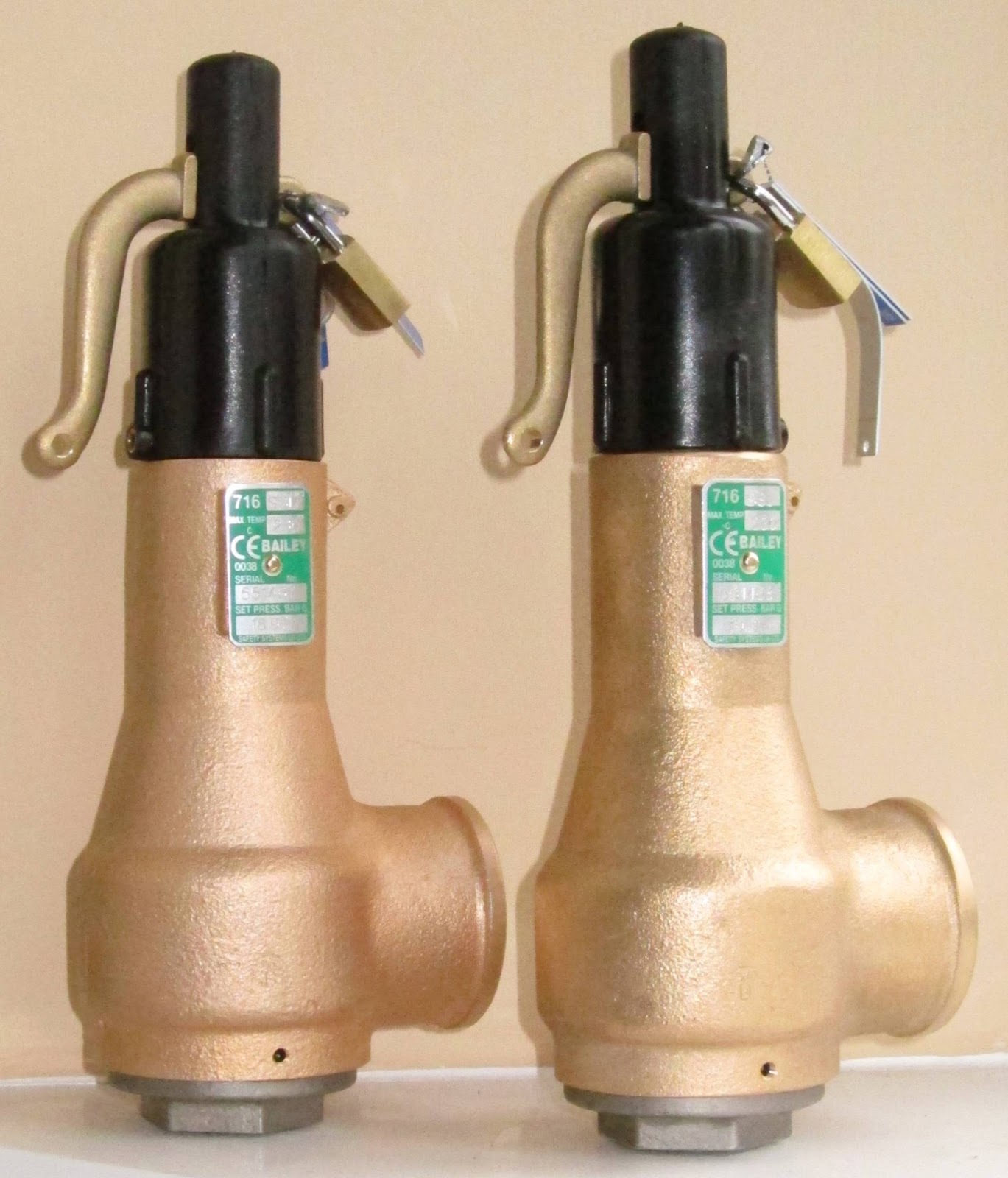
I introduced the new pair of Bailey-Birkett type 716SSL safety valves a little while back. I've now obtained the supporting steel pipe fittings and constructed the new support manifold.

Whilst on the surface this construction seems fairly straight forward, it is a safety system and therefore requires rather more formal engineering processes to ensure it is fit for purpose. (It's also my safety I'm concerned about!).

Before I retired, I spent many years on railway signalling and control centre research and development projects. Most were computer based and hence involved formal safety related system/software development project 'V' life cycles. ('V' implies: Define what it has to do; design it; implement it; test the implementation; test it meets the design; test/assess whether it does what it was defined to do originally. And don't forget the traceability!).

Safety valve pipework is somewhat more tangible than software so it would be over the top to do all that but some allusion to the principle is worthwhile.

Requirements:

Firstly, what are the requirements (i.e. WHAT does it have to do)?

The pipework shall:
1. Withstand 275psi.
2. Withstand 230DegC.
3. Support the safety valves.
4. Support the exhaust outlet pipework.
5. Allow the full output of the boiler to pass to the safety valves (4600 lbs/hour).
6. Connect to the original Sentinel boiler flange mounting.
7. Prevent condensation accumulating in the exhaust (i.e. to prevent showering nearby onlookers when the safety valves blow off!).
8. Enable easy removal of the Safety Valves for hydraulic boiler testing.

Design:

Requirements 1-8 are ultimately tested or observed; however, they all need to be taken into account during the design process.

Requirements 1 and 2 (275psi & 230DegC) are satisfied by choosing to use mild steel pipe and fittings and avoiding the weaker malleable iron which is not up to the job. It also requires that a flange to connect to the existing Sentinel flange has to conform to BS 10 (1962) Table F or better.

Requirement 3 is satisfied, firstly, by ensuring that there is a vertical 3/4" male BSP thread to connect to each safety valve and, secondly, by using sufficiently heavy gauge material.

Requirement 4 is satisfied again by using the heavy gauge material. Additional support from the cab roof may also be included later to support the exhaust pipework.

Requirement 5 is satisfied by ensuring that there are no parts of the pipework that are of a smaller diameter than the 3/4" inlet to the safety valves.

Requirement 6 is satisfied by using a compatible flange. Easy you would think but when Sentinel made their safety valve mounting, there were no standard flange sizes and ratings! So the nearest standard type needed to be chosen that involved minimal adaptation.

This resulted in a Carbon Steel flange as follows:
A screwed flange of nominal bore 1.5" (to allow a male 1.5" BSP thread to be attached).
A BS10 Table 'F' type capable of 300psi at 232.2DegC.
5.5" Diameter.
Four holes 11/16" diameter on a pcd of 4.125" to fit 5/8" studs.
0.5" thick.

The four mounting holes had to be elongated slightly to fit the Sentinel flange.

The flange dictated that 1.5" pipework had to be used which conveniently led to the considerable strength of the final structure and avoidance of any diameter less than the 3/4" inlet to the safety valves (requirement 5).

Requirement 7 is satisfied by including narrow bore draining pipes in the exhaust pipework.

Requirement 8 is satisfied by incorporating unions into the exhaust pipe elbows so that the pipe can be detached easily. The safety valves can then be unscrewed without having to take the exhaust pipework apart. A cap is screwed onto the 3/4" male thread to seal for hydraulic boiler testing.

Implementation:

Below is an early mock-up I did at South West Engineering Supplies to get the hang of the idea. It was not the first attempt; I started off using 3/4" pipe bends from the 'T' piece to the base of the valves but did not believe it was a strong enough structure to carry the weight.
Early Mock-up
The implementation evolved to the final version by using shorter 'running' nipples having no plain centre section to keep the links as short as possible and by using single piece reducers to convert from 1.5" to 3/4" diameter fittings. Thus I believe I've minimised the number of thread interfaces and maximised the strength of the structure.
The Final Version
The black 'stuff' on the threads is a jointing compound from Rocol called 'Steamseal'. It is more technically called 'Foliac Graphite and Manganese' and is specified to be able to withstand steam pressures up to 2800psi at temperatures up to 600 DegC. Good stuff! Easily exceeding requirements 1 & 2.

At this stage, requirements 1-6 have been embodied into the design and implementation.

Requirement 7's condensate draining pipe is shown below.
Condensate Draining Pipe (bottom left)
To prevent a condensate pool accumulating, the small brass fitting had to be machined so that it would not protrude into the large pipe.
Flush Drainage hole
I hope I've demonstrated how setting out the requirements before design and implementation drives towards a compliant solution. Often, it's easy to assume that what has been done before will do but that approach tends to only just get what you want if you are lucky and doesn't cater for doing something that hasn't been done before.

Of course, if you haven't got ALL the requirements identified at the start, you may still not get what you want!

Next to do is the upward exhaust pipework.

Tuesday, 21 May 2013

Water Supply (1)

One item that was missing when Sentinel 7109 arrived at Midsomer Norton Station in 2004 was a section of water feed pipework running around the front of the leading engine supplying water to its boiler feed pump.

I decided that the simplest way for me to make this was using mild steel pipe with malleable iron fittings and here it is.
Water feed pipe to front engine's Feed Pump
I concluded that the best method of joining the new pipe to the old and to the pump itself was by using parts from a union fitting. Nominal 1 inch inside diameter unions made by Crane use a 1.5 inch BSP thread for the union join - the same as at either end. Thus I was able to achieve joints without any air pocket. Other methods such as off-the-shelf reducer fittings have a bulge where you don't want it!
Water feed pipe across from left to right
For water systems under pressure, an air pocket is not an issue but where water has to be sucked by the pump from the tank, the air pocket will prevent the suction taking place.
Water feed pipe past the rear engine from
the water tank filter valves
Note: Crane and (I think) Georg Fischer unions use 1.5" BSP joint threads for 1" pipe; others I bought via the internet do not. Beware!

Sunday, 28 April 2013

Boiler Fittings (7)

Following previous articles on the boiler fittings, here's some photogenic progress:
RHS Gauge Glass Valves & Protector
In an attempt to check that the gauge glass valves and protector fitted correctly, I placed them on the right hand boiler location.

I'm glad to say that they fitted perfectly although the boiler studs will need shortening so the nuts don't foul the valve mechanism.

Sentinel 7109's gauge glass valves are different to ones that can be bought off the shelf today. As a result, off the shelf protectors wouldn't fit without being modified.

Whilst visiting family in Wakefield, I made a trip to Chanter Biomed Ltd in Bradford, Yorkshire, seemingly the only company to be still making these fittings in the UK.

On being able to handle the Sentinel valves, CB were able to turn out a special pair of made-to-measure protectors overnight. I was really pleased as this meant they were bought, made and collected within 24 hours. It's a pleasure to receive that kind of service so CB are definitely on my list of preferred suppliers for the future!

Thursday, 28 March 2013

A Nice (Replacement) Pair!

Those of you who have been following the 'blog for a while will know that the restoration started out with a number of original bits missing. One by one, I've been acquiring or making replacements, sometimes authentic to the originals but not always. One example of the latter is the safety valves.

A typical Sentinel safety valve assembly is shown in the picture below which belongs to Isebrook at Quainton Road. It is very much an integrated assembly with the lower casting having the valve seats. Unless all the parts are present, this is not going to be an easy reconstruction - particularly as it needs to be accurately calibrated for the release pressure.
Isebrook's (6515) Safety Valves
Long ago, I concluded that this approach belonged in the 'too difficult pile' and that modern items should be used instead. (Later, if suitable authentic items become available, who knows what may happen but at least I know that the safety system will be reliable and accurately calibrated).

So these are the new devices: Bailey Birkett type 716SSL, size DN20 with the inlet below (3/4" BSP) and outlet to the side (1 1/4" BSP). One is set at 275 psi (18.97 bar) and the other at 280 psi (19.31 bar). The SSL part of the type indicates that the valve seats are made of stainless steel to handle the elevated boiling point found at 275 psi. Many thanks to South West Engineering Supplies of Chippenham for obtaining these.
Joyce's (7109) Brand New Safety Valves (1)
Each has the capacity to release the entire boiler steam output alone (4600 lbs/hours or 2087 kgs/hour).
Joyce's (7109) Brand New Safety Valves (2)
Now for the plumbing! Again, as the pressure is 275 psi, malleable iron pipe fittings are just able to withstand the working pressure but without a good enough safety margin. As a result, mild steel fittings and pipe work will be used.


Tuesday, 9 October 2012

Appeal for help

I've been struggling to find suitable replacements for the four 15 inch diameter, circular, 'spectacle' cab windows for Sentinel 7109's restoration.
Front pair of 'spectacles' from an old photo
Ideally, I would like genuine Sentinel windows as used on many of their early locomotives but alternatives may be suitable. They pivot about a vertical centre line as shown in the right of the picture.

The original windows were lost during transfers between previous owners and have never been found.

Can anybody help please?

My Email address can be found as the Steam Locomotive Officer here: http://www.sentinelwaggons.co.uk/7.Contact/Club%20contacts.pdf

Sunday, 12 August 2012

Snibston, Chasewater and The Missing Bits

Early in 2012, I visited the Chasewater Railway at Brownhills, north of Birmingham. While talking to some of the staff, it became obvious that a number of them were very familiar with Sentinel 7109. The reason for the familiarity was from their interest in purchasing 7109 at the time when MSN volunteers finally purchased it late in 2004. Moreover, I was stunned when told that one of their staff (absent that day) knew that there were some of 7109's missing parts in a particular goods wagon at Snibston Colliery at Coalville.
Not this particular wagon!
This was too good an opportunity to miss so I contacted Snibston and was put in touch with Nick Pell, their museum curator of mining and transport. Nick, also a volunteer at the Welsh Highland Heritage Railway, Porthmadog, could not have been more helpful but, after some searching himself, was highly pessimistic that the parts could be at Snibston. I arranged to visit him there on 31st July 2012.
Prior to the visit, I had also been in touch with Mark Sealey, General Manager at Chasewater. He was more confident that there could be some parts at Snibston and even suggested where to look.

Come the day, Nick kindly led us on a thorough search but to no avail. It also became clear that the wagon in question had been one of five originally at Snibston but they had all been transferred to Chasewater about five years earlier.

So a visit to Chasewater followed as it was close on the way home.
I found the five wagons.
The five(ish) wagons at Chasewater Heaths Station
There was nothing in them, let alone any Sentinel parts.

I rang Mark Sealey later to discuss the search but had to conclude that this was the end of the line and that the parts really had disappeared. A pity. We'd had high hopes of finding our spectacle windows and safety valves if nothing else.

It was an opportunity that could not be ignored but in the end no joy! If anybody does know the whereabouts of any of these parts, do (please) post me a comment below and I'll contact you to discuss possibilities.

Monday, 13 June 2011

Sentinel 7109 - Bits Missing

When Sentinel 7109 arrived at Midsomer Norton Station in December 2004, not everything was present. It was missing the following items:

Although many items have been sourced, any offers of suitable replacements for the missing items will be welcomed with open arms!
Related Posts Plugin for WordPress, Blogger...